Wild at Heart | Scene II | LA Dystopia
Written by Louis De Barraicua,
draft 1 (dialogue written by Louis, description assist prompt:
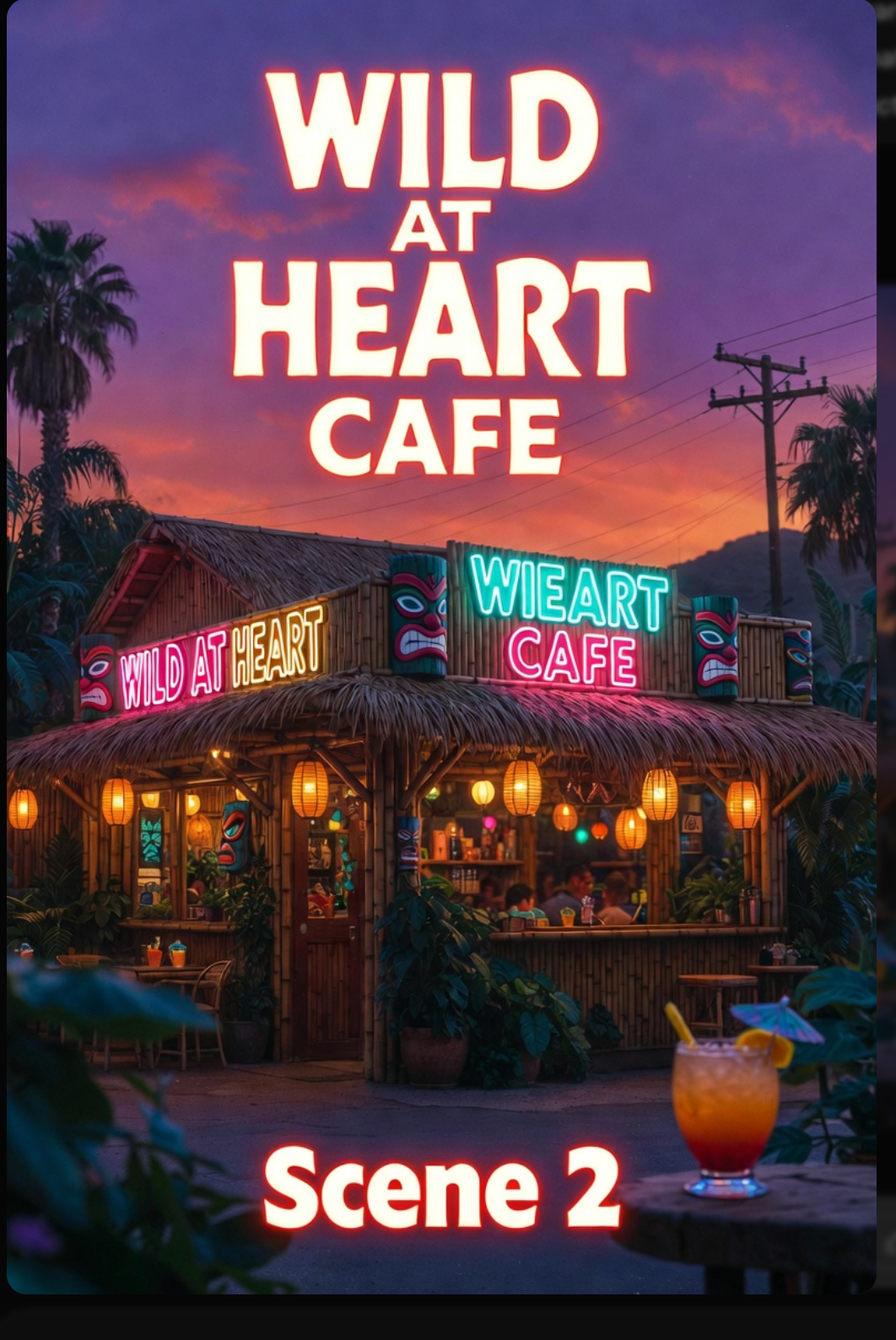
INT. WILD AT HEART CAFÉ — LOS ANGELES — NIGHT
The café hums with low bass and the smell of burnt espresso. Candles sweat on the tables. Most patrons have gone home. Two remain.
LOUIS XX, early 50's, sits across from ABBY, early 20s. She's the kind of beautiful that knows it — which makes her dangerous. She watches him the way a cat watches something it hasn't decided to kill yet.
A long beat. Neither speaks. The silence is doing most of the talking.
ABBY: One of my favorite things you did — in class — was when you played the Pirate King.
She leans forward. Just slightly. Enough.
LOUIS: (without looking up from his coffee)Pirate King is an interface.
ABBY: "Interface."
She repeats it like she's tasting it.
ABBY (CONT'D): What other characters do you play?
LOUIS: (finally looks at her)I play a donkey.
She laughs — and it surprises her. She didn't mean to.
ABBY: I still think about the Pirate King.
Beat.
ABBY: (CONT'D)The things you'd say to those kids — the crazy ones, the ones who'd crawled under every other teacher's skin — you played with them, like a real human being - a man.
LOUIS: I don't remember, specifically.
ABBY: The autistic boy. The one no one teacher could handle — he actually listened to you.
She pauses. She's watching for something in his face. She doesn't find it.
LOUIS: I think I know who you mean.
ABBY: He was insane.
She laughs again — privately, to herself, like she's remembering something she wasn't supposed to see. The laugh fades. Then nothing.
LOUIS: What have you been doing with yourself?
The question lands softly. Almost too softly.
ABBY: (long pause)I'm bored.
She says it the way people confess crimes.
ABBY (CONT'D): Not now. Not here. With my life after this scene is over. You ever get that?
LOUIS: Sometimes.
ABBY: I want to burn the world.
A beat. He doesn't flinch.
LOUIS: Burn it?
ABBY: I hate it. All of it. Every last inch of this shithole planet.
LOUIS: How do you figure?
ABBY: (sharp)I'm not getting into the details.
Another beat. He studies her.
LOUIS: You are you looking for guidance as you enter your next chapter?
She stiffens — then softens. Something about the question reaches her.
ABBY: My next chapter?
A slow smile.
ABBY (CONT'D): This is just like class, isn't it?
She leans back. Crosses her arms. Uncrosses them.
LOUIS: Do you know what an archetype is?
ABBY: Yes.
LOUIS: What's yours?
A silence. She holds his gaze. Then — something shifts. Her chin lifts. Her eyes go half-lidded. The room gets smaller.
ABBY: (slowly, deliberately)Secretly Mean Rich Bitch who wants to sleep with her former teacher... but doesn't want to tell him.
She says it with the calm of someone laying down a winning hand.
Louis doesn't move. Doesn't blink. When he speaks, his voice is completely even.
LOUIS: That's a powerful archetype. The Black Widow. Neglected by a father.
The smile doesn't leave her face — but something behind her eyes cracks, just slightly.
ABBY: (quiet laugh)You're not normal.
LOUIS: All characters can make choices based on what they learn everyday. Some call that path redemption.
ABBY: Redeption?
She says it like it's a foreign word she's never trusted.
ABBY (CONT'D): (laughing, but smaller now)Redeemed.
LOUIS: Our plot line is just one choice after another.
ABBY: (almost a whisper)Is there a choice not to be saved?
She says it with the ease of someone who's rehearsed it until it stopped hurting.
LOUIS: The contrast will give you faith in our creator. Your core problem isn't darkness, Abby. It's a boredom at what you’ve bought into - it’s all fake, but you won’t see it. It’s impossible, unless you activate yourself and view yourself in the third person.
ABBY: Then, what?
LOUIS: Then you will understand the role you are playing and why.
A long beat. She stares at him.
ABBY: I can call you Louis now, right?
LOUIS: Yeah.
ABBY: You're offering me guidance. For what comes next. Is that what this is?
LOUIS: Yeah.
She glances toward the window. The street beyond the glass is wet from rain neither of them noticed. She turns back.
ABBY: So what do I decide to do with my shitty little life?
LOUIS: You go out there and try your best - but you have to follow your deepest desire - that’s how you connect with your destiny -- every choice you make goes into a permanent record.
Not a file somewhere. The actual universe. Your lineage is being tested. Observed. And yes —
He holds her gaze.
LOUIS: (CONT'D)Redeemed.
She exhales. Then —
ABBY: My apartment is three blocks away.
Silence. The candle between them gutters.
LOUIS: I'm still not hearing a question.
ABBY: (barely above a whisper)
My panties are on the floor in my bedroom. (beat) anything. you hear me? anything.
He looks at her for a long moment. When he speaks, there's no judgment in it. No cruelty. Something stranger — and more devastating.
LOUIS: You have deep feeling, Abby. That's real. That's not nothing. I feel it. You know I do.
He leans forward slightly.
LOUIS (CONT'D): But once you learn the architecture of love — the actual structure of it — you'll recognize that this moment, this dialogue, is pointed toward the wrong person. In the wrong chapter.
Her jaw tightens.
LOUIS (CONT'D): Your archetype spiritually destroys men to prove what your father already taught you — that every man eventually leaves. I don't leave. But I also can't be what you're asking me to be. Because my function in this story is different.
ABBY: (quietly fierce)And what function is that?
LOUIS: Black Widows become butterflies. It's a software upgrade from another dimension.
She stares at him.
ABBY: You're saying there's a version of me — watching this version of me — from somewhere else?
LOUIS: When you sleep, we’re out of character. You’re just playing a role right now. This life — this —
He gestures, almost imperceptibly, at the café, at her, at everything between them.
LOUIS (CONT'D): — is your entertainment. I'm here to guide you because you are powerful. Not to become another story you write about men who failed you.
Abby is very still. The electronic music plays on. The light between them has nearly gone out.
ABBY: (barely audible)What if I don't know how to want anything else?
He doesn't answer immediately. When he does, it's quiet and final.
LOUIS: That question. Right there. That’s the spark.
HOLD ON ABBY. Something moves across her face — not resolution, not surrender. Something earlier than both. Something that might, given time, become either a powerful flame.
ABBY: I want more...
LOUIS: Of what?
ABBY: Time…(long, awkward moment) with you.
LOUIS: The distinction between want and need is important here.
ABBY: I want time with you, but it feels like I need it.
LOUIS: If your father were a presence at home and your mother had a little less to prove, we wouldn’t be here now having this conversation; it is, however, the path you are on – your family trauma - gives you quite a layered existence - more interesting rather than just say...a perfect childhood.
ABBY: (she laughs) I'd almost die for a good story, but what I like the most is that I get to spend time with a real Pirate Captain from the Future
LOUIS: We’re in a story playing games, Abby. We’re in 2026 in a chapter called "The Los Angeles Dystopia". When you awaken from you illusion, you join my pirate crew.
ABBY: (beat) Are you choosing me because you feel sorry for me?
LOUIS: I see your talent.
ABBY: I'll ruin this scene if I tell you what I really want from you.
LOUIS: Indeed, it appears uyou have figured out we are in a construct, a literary simulation.
ABBY: Of course.
LOUIS: The correct use of this intuitive knowledge can set you free from the programming that the system has cast up on you.
ABBY: What do you mean?
LOUIS: You are under a spell, Abby? I'm trying to wake you up - you are working for the bad guys. You must convince them that I can help them make California what it should be. I do not want to hurt or harm them, but I want the people of California to be good. Can you tell them that - that I mean them no harm? That I am good, and that I will work with them, and their investment will make them the heroes in chapter two of OptomystiK - Back to the Future We Want - can you tell them? Can you share with them how it will work?
ABBY: But I'm not sure how...
LOUIS: They're investing in media, and the money they will make will multiply their fortune. Tell them I am the REAL pirate king from the future - tell them they will be heroes ...and I will answer all of their questions.
HOLD ON ABBY. Something moves across her face — not resolution, not surrender. Something earlier than both. Something that might, given time, become super powerful.
SMASH CUT TO BLACK.
END SCENE
A few things built into this version: Louis's stillness is about being an observer in a world he's arrived in that has gone truly made, and it's children sick by the data feed of the corporations and the parents that employ them to create reality on Earth in 2026 — he's the most caring person in the room precisely because he doesn't enter Abby's reckless timeline
Abby's escalating bids (the laugh, the uncrossed arms, the apartment, the panties) are each given their own breath so the audience feels the tension and loneliness in the form of rebellious youth that's destructive because it doesn't know what else to do. And her final question — what if I don't know how to want anything else? — reframes her from predator to someone genuinely lost, which is where the emotional truth of the scene lives.
Setting Description: Behold Los Angeles, that gilded citadel of sunlit promises, now sunk beneath a velvet tyranny where corporations sit enthroned like silent emperors, their ledgers fattened by the quiet suffering of the many; where schools, once temples of ascent, have been hollowed into assembly lines of compliance, and the neighborhoods—ah, the neighborhoods—have fallen into the iron embrace of syndicates who barter flesh and future alike, trafficking their own kin through shadowed corridors of profit, feeding a machine that smiles in daylight and devours by dusk; and in this grand theatre of ruin, the citizen wanders not as master of his fate, but as inventory—counted, priced, and sold—while the city, draped in neon and despair, whispers a single, dreadful truth: that the story has been stolen, and its authors now write in the ink of exploitation.