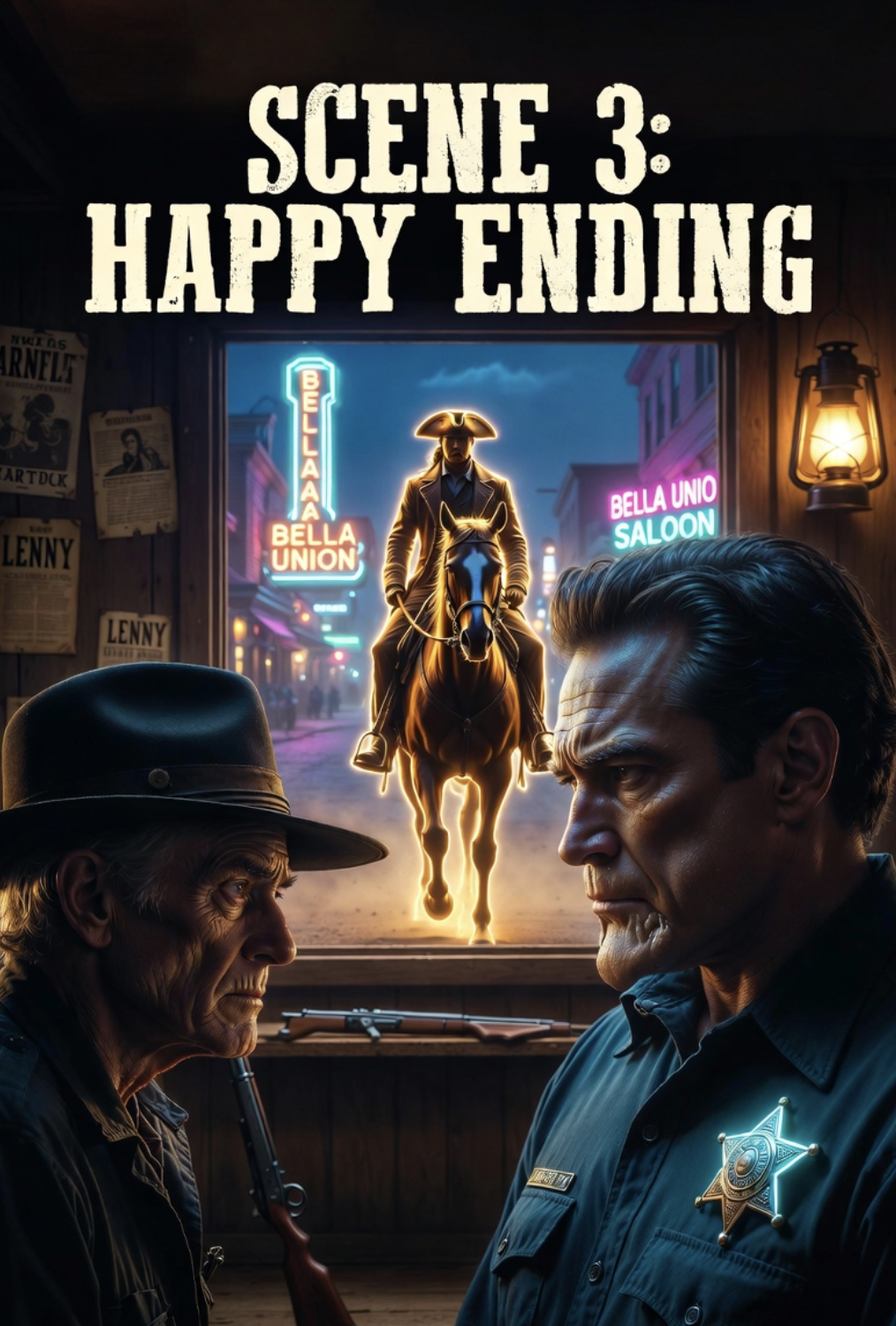
LENNY'S unwanted "HAPPY ENDING" SCENE III
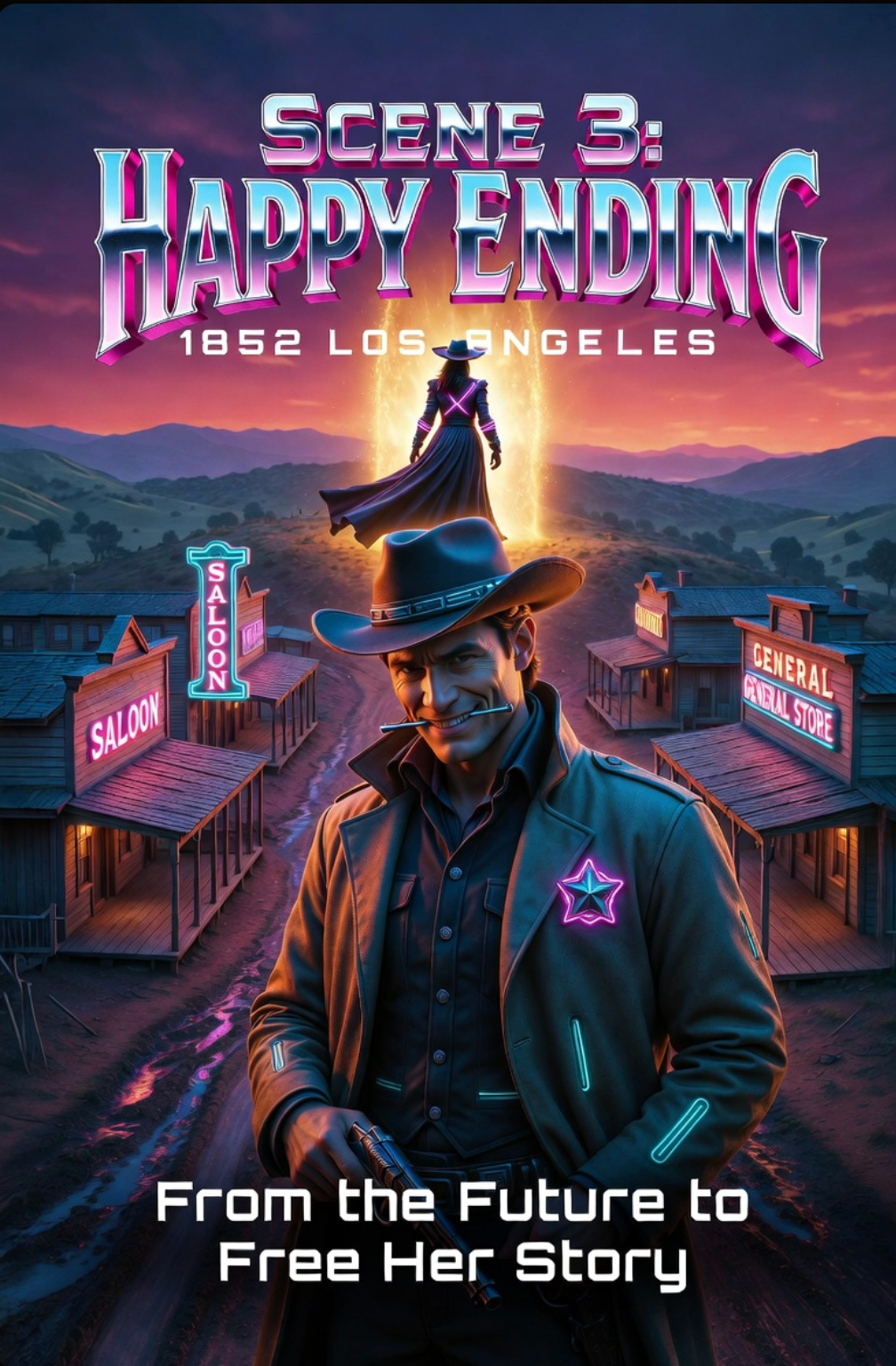
Scene 3: ON THE TRAIL OF A “HAPPY ENDING”
EXT. LOS ANGELES — MORNING
Hark — here I pause upon the Road of Gold, that impossible meridian between what was and what shall be, and look down with the eye of one who has sailed stranger waters than these men have ever dreamed. Below me sprawls Los Angeles as she was in her sinful infancy: a town of perhaps sixteen hundred souls perched where the Los Angeles River coils lazy and brown through the chaparral, a settlement the Californios called El Pueblo de la Reina de los Ángeles before the Americans came and shortened beauty into commerce. The Treaty of Guadalupe Hidalgo has scarcely four years of age upon it, and already the gringos have made of this place a theatre of appetite — a main street of mud and ambition called Calle Principal, where the Bella Union Hotel serves as courthouse, saloon and rumour mill at once; where Chinatown begins its first shy crouch along the river; where Former Black Slave Alley — God forgive the name they gave it — roars with vice and blood enough to embarrass even Sodom. There are more pistols than Bibles here, more corrupt alcaldes than honest ones, and the law, such as it is, wears a badge the way a scarecrow wears a hat — decoratively, and with no great conviction. It is into this republic of rascals that I, a captain of futures and liberator of narratives, have sailed. And it appears I have caused a stir.
INT. SHERIFF'S OFFICE — CONTINUOUS
The sheriff's office is a room of simple villainies: a rack of rifles oiled more than they are needed, a desk scarred by boots and boredom, a tin star that catches the morning light coming through the single window that faces the street where the dust never quite settles. Behind that desk sits Luke — thirty-eight years of age, broad-shouldered, the jaw of a man who has never once doubted his own magnetism, and quite right not to. He is the kind of lawman this era invents by accident: genuinely decent within a system that rewards neither decency nor accident. Across from him, by the door, stands Lenny — old enough to have forgotten why he came out of retirement, young enough still to resent the answer. From my perch upon the Road of Gold I watch them, these two inheritors of a town they did not build, speak of me as though I were a rumour and not a certainty.
LENNY
Newcomer is causing quite the stir.
And here I confess — from my golden meridian — that I smiled. Quite the stir. I have capsized frigates, I have disrupted the orderly tyranny of lesser stories, I have appeared in the drawing rooms of century-turning moments wearing the wrong coat and the right intention. A stir is the least I could offer this particular pueblo.
LUKE
He cool. Ya'll making too much of a fuss of this guy.
Bless him. Luke — a true man of California’s frontier, that lantern-jawed inheritor of Emersonian self-reliance — he sees it clearly. The provincialism of envy, that oldest of frontier diseases, had already broken out among the townspeople like a rash. I had arrived with too much style and insufficiently apologised for it. This is the crime they cannot forgive in any age.
LENNY
You know what he told Virginia?
LUKE
You're too old for me?
Luke improvises the way the river improvises: naturally, without consultation, going wherever the gradient of wit leads him.
LENNY
That he was a pirate captain from the future and that he was here to rescue her from the bullshit story she was in… he told her he was going to liberate her — get her free or something so she don't have to —
LUKE
Sounds peasy to me.
Indeed. Peasy. For it was the truth in its plainest dress, and truth, in my experience, is only threatening to those who have built their comfort upon its absence. Virginia's story — the particular bullshit story she inhabited, as Lenny so accurately named it — was the story this town had written for every woman who passed through its jurisdiction: that she existed for utility, for decoration, for the convenience of men whose own stories had run dry. I had merely offered her an alternative volume. A newer plot. A page where she was the subject of the sentence rather than its object.
LENNY
What kind of man says he's from the future unless…
LUKE
He's from the future?
A fair deduction, Sheriff. A fair deduction.
LENNY
I don't trust him.
And here the Road grew warm beneath me, as it does when something ancient and true is spoken. Lenny does not trust me. He is correct not to — not because I am dishonest, but because I am other, and in 1852 Los Angeles, as in most of human history, otherness was the original sin. I had arrived from no recognisable direction, owed no debts to the right men, bent my knee to no alcalde, greased no palm at the Bella Union. Worse: I carried myself like a man who had already seen how the story ends and found it insufficient. This Los Angeles — this corrupt little outpost where the Monte card games never stopped and the acequias ran brackish and the law was a social arrangement rather than a moral one — this place had decided it would prefer I be villainous, because villainy is at least a category it understands.
LUKE
I'm not sure I trust the way you spend your time, Lenny. If you worked for me I'd have fired you just from watching the way you waste your time.
LENNY
What you mean by that?
LUKE
You don't make no sense the way you think, Lenny. You a crazy man, but you entertain me, alright — I'll give you that.
Luke has the diagnostician's gift: he sees Lenny for exactly what he is — a man who has mistaken his anxieties for intelligence, his suspicions for wisdom, his retirement for a second calling. Lenny is not evil. He is something more pitiable and more common: he is a man whose imagination stops at the edge of the familiar, and calls that edge the edge of the world. Such men have always been the engine of persecution — not from malice, but from the terror that someone else might be living in a larger universe than they have been permitted to perceive. I have met a thousand Lennys upon this Road, in a thousand towns, in a thousand years. This one has a chance to be remembered.
LENNY
I'm not sure I like your tone.
LUKE
This is America, Lenny. The concept is freedom — remember 'dat.
The word hangs in the dust-light of the office like something half-uttered by God and left for men to finish. Freedom. Oh, this young republic and its favourite word — spoken in 1852 by a man in a land where the ink was barely dry on the treaty that had taken California from one empire and given it to another, where enslaved men and women still laboured in the cotton states, where the indigenous Tongva people upon whose very ground this office was built had been dispossessed with a thoroughness that put the old world's wickednesses to shame. Luke means it, though. I believe that of him absolutely. He means it the way the young mean everything — with the full force of what they have not yet seen. And perhaps that is enough. Perhaps meaning a thing fully is the first necessary condition of making it real.
I rise from the Road. I settle my coat. Virginia is somewhere in this town, and her story is not yet written — which is precisely why I came.
End of Scene III