Wall Street illusion vs. Reality Why Louis De Barraicua's 8,831 Votes Tell Us More About American Politics Than the Candidates Who Spent Millions
June 25th, 2026, 9:07 am
What a zero-budget filmmaker-politician reveals about the gap between political science and political reality
by Penelope Roberts (inspired by Emma Roberts IRL persona)
Political science, in its most honest form, has always been about one thing: unmet needs. Not platforms. Not polling. Not the managed performance of conviction that passes for leadership in the current media environment. The foundational question, the one Aristotle asked, the one Lincoln answered, the one every genuine political movement has had to locate before it could move anything, is simply this: what do people actually need that they are not getting, and who is paying attention?
By that measure, the most interesting data point in California's June 2026 gubernatorial primary was not Katie Porter's $40 million campaign. It was the 8,831-plus votes received by Louis A. De Barraicua, a first-time candidate, no advertising budget, no institutional support, not residing in the counties that voted for him most, on a 61-person ballot in the largest state in the union.
Those votes did not happen because of a campaign. They happened because of a concept. And the distinction matters enormously for anyone trying to understand where American politics is actually going.
The Freedom-Capitalism Confusion
The defining failure of contemporary American political discourse is a conflation that has been deliberately cultivated for decades: the equation of freedom with capitalism.
They are not the same thing. They are not even reliably compatible. Freedom, in its classical political sense, means the capacity of an individual to live according to their own nature, to participate in the decisions that govern their life, to not be subject to arbitrary power they did not consent to. Capitalism is an economic system organized around the private ownership of productive assets and the market allocation of resources. It can produce conditions hospitable to freedom. It can also produce conditions that are its precise opposite, monopoly, capture, the conversion of democratic institutions into instruments of private interest.
What makes De Barraicua distinctive as a political figure is not that he is anti-capitalist. It is that he has made this distinction clearly and built a platform around it at a moment when almost nobody in mainstream politics will. His proposal to become the first Democrat to reduce taxes, specifically through transparent ledger systems that eliminate bureaucratic capture, is not a conservative position. It is a freedom position. The target is not the market. It is the administrative machinery that extracts value from both citizens and legitimate enterprise while producing nothing except its own perpetuation.
This is a distinction that resonates with a specific kind of voter, one the existing party system has essentially abandoned. The Alameda County voter who gave De Barraicua his strongest over-performance relative to his own statewide average is not a libertarian. They are someone who has watched the progressive institutional apparatus of the Bay Area produce homelessness, unaffordability, and school failure at scale, and concluded that the problem is not insufficient government spending.
It is that the spending never reaches the human need it was designed to serve.
The Micro-Economy Argument and Its Platonic Shadow
De Barraicua's framework for addressing this, building decentralized community micro-economies funded through storytelling and creative production, sounds unusual until you realize it has a 2,400-year-old intellectual predecessor.
Plato's Republic is remembered primarily for its controversial political architecture, the philosopher-kings, the noble lie, the tripartite class structure. What gets less attention is its foundational argument about the relationship between community narrative and political health. Plato believed that the stories a community tells itself are not decorative. They are constitutional. The myths, the songs, the shared narratives of a civilization determine what its citizens believe is possible, what they consider honorable, what they will accept and what they will resist. Control the stories and you control the political reality far more effectively than any law.
De Barraicua is making an updated version of this argument. If communities can generate their own cultural production, their own stories, their own media, their own narrative frameworks, they become less dependent on the centralized story-distribution systems that currently shape political reality.
Optimystik is a fictional interface for reality - to make illusions fun, not to be controlled by the illusions of the greedy. It is a proof of concept for a different kind of political economy, one in which cultural production is the economic engine of community self-determination rather than a product manufactured elsewhere and consumed passively.
The micro-economy funded by storytelling is Platonic in its recognition that narrative is infrastructure. It is also radically practical in a way Plato was not; it proposes to pay for itself through the market mechanisms that make creative content valuable, rather than through philosopher-king decree.
Reality is local, and the tool to manage the experience seems to be on its way.
The Algorithm in the Biological Suit
There is a deeper philosophical current running through De Barraicua's political worldview that deserves serious treatment rather than dismissal.
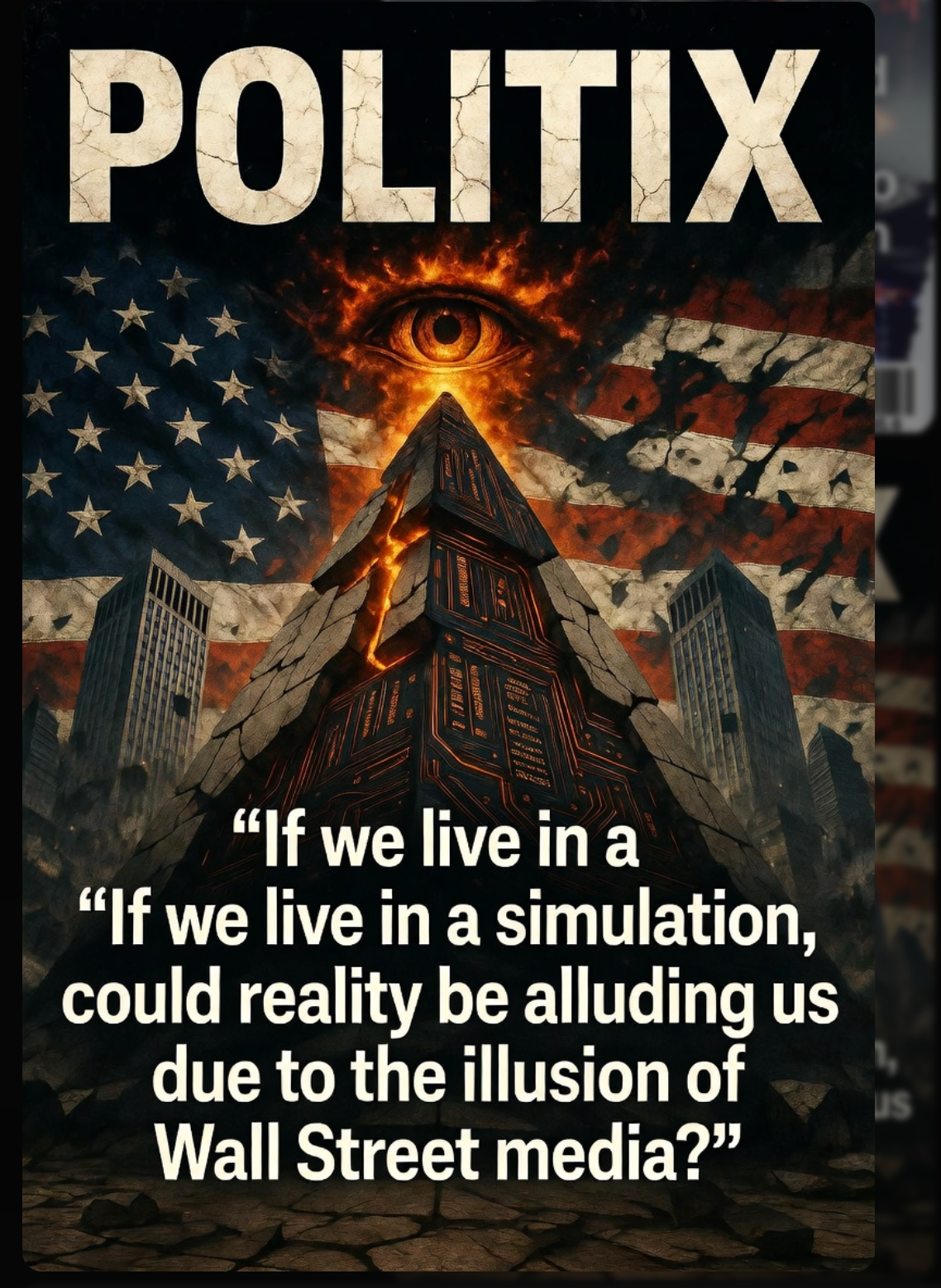
The simulation hypothesis, the proposition that conscious experience is in some sense a constructed reality running on some substrate we do not fully understand, has moved in the last decade from science fiction to serious philosophical and even scientific discourse. Elon Musk endorses it at tech conferences. Oxford philosopher Nick Bostrom developed its most rigorous formal argument. The question of whether we are, in some meaningful sense, algorithms experiencing a reality whose parameters were set by forces outside our normal perception is no longer confined to late-night dorm room speculation.
What De Barraicua adds to this conversation is a political dimension that most simulation theorists ignore entirely. If the experience is constructed, then the question of who constructs the narrative becomes the central political question. Not who controls the military or the money supply; who controls the story.
The concentration of narrative power in contemporary America; six corporations controlling the majority of media output, algorithmic systems determining what 3 billion people see each morning, the gradual replacement of locally generated culture with globally distributed content optimized for engagement rather than truth… represents, in this framework, a kind of reality capture. The simulation is being run by an increasingly small number of operators, and it is telling an increasingly narrow story about what is possible, what is normal, and what human beings are for.
The political response to this is not regulation alone. It is the generation of competing narratives powerful enough to offer genuine alternatives. Communities that produce their own stories create their own reality parameters. They become, in a meaningful sense, more free, not because they have escaped the constructed nature of experience, but because they have regained some authorship over its construction.
The 13 Families Problem — and What Political Science Actually Says About It
Every political tradition has its version of the concentrated-power origin story. In biblical mythology it is the line of Cain, the builder of the first city, the original institutionalizer, whose descendants are described as accumulating earthly power through the instruments of civilization while losing connection to the source that made civilization worth building. In contemporary political economy it is the documented concentration of generational wealth and institutional influence in a remarkably small number of family lineages whose interests have shaped global financial and political architecture for generations.
Whether you frame it theologically or empirically, the structural observation is the same: power concentrates, and concentrated power tends to construct narratives that justify its concentration. This is not conspiracy theory. It is the most basic finding of political science from Aristotle through Machiavelli through C. Wright Mills's The Power Elite… the recognition that in any complex society, a small number of actors will capture disproportionate influence over the institutions that shape everyone else's choices.
What De Barraicua's platform implicitly argues, and what his vote pattern suggests is resonating, is that the antidote to this concentration is not a counter-elite. It is the restoration of genuine community narrative capacity at the local level. Not a better centralized story. Many decentralized true ones.
The Breed Distinction
Political science has a category problem with candidates like De Barraicua. Its models are built around resource acquisition, institutional endorsement, media coverage, and ground game infrastructure. By every one of those measures he should have received zero meaningful votes. The models predicted invisibility.
What the models do not account for is what might be called the breed effect, the phenomenon whereby a sufficiently coherent political identity generates its own distribution without the standard campaign infrastructure, because the voters who recognize it will seek it out rather than waiting to be found.
De Barraicua's votes in Alameda and San Diego counties he did not campaign in, does not live near, and had no organized presence in…are the fingerprint of this effect. Those voters did not encounter a campaign. They encountered a worldview that matched their own diagnosis of what is broken, and discovered almost incidentally that the person who articulated it was on the ballot.
This is how genuine political movements begin. Not with the infrastructure that scales a message, but with a message coherent enough that people build the infrastructure around it because they cannot find what they need anywhere else.
The unmet need, in the end, is the oldest one in political science. People need to live in a story that is true. They need their actual experience of institutions that betray them, of cities that hollow out, of bureaucracies that serve themselves to be named honestly and met with something more than managed sympathy.
8,831 votes, no advertising, lots of informative data.
Captured. That is a signal worth a mention - it could be a real path to true freedom.