The LAUSD School Board Protects itself by controlling the Inspector General
Who Really Runs Our Public Schools?
In the American imagination, public schools remain tidy democratic vessels—little republics steered by elected boards, answerable to voters who show up at meetings with folding chairs and strong opinions. The reality, especially in a district as colossal as Los Angeles Unified, is something closer to a supertanker: immense, slow to turn, crewed by layers of professionals, and navigated through fog banks of contracts, partnerships, and institutional memory that most citizens will never see. The question is not whether shadowy corporations have lashed themselves to the helm in some grand conspiracy. It is whether the rest of us—parents, taxpayers, citizens—have any reliable way of knowing who is actually holding the wheel.
The Watchdog on a Leash
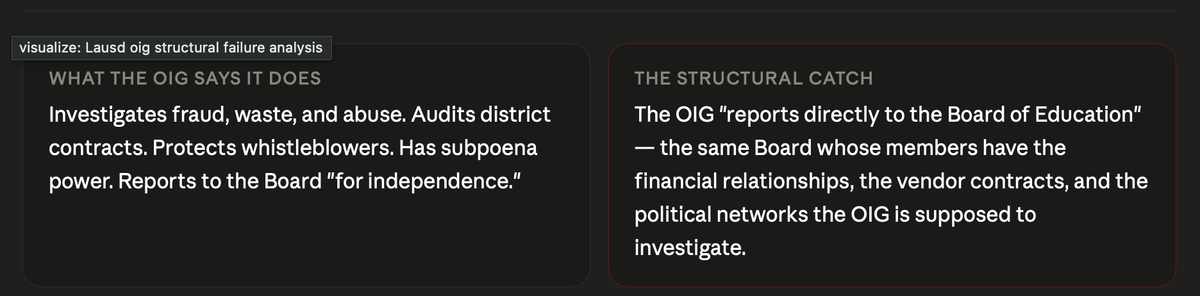
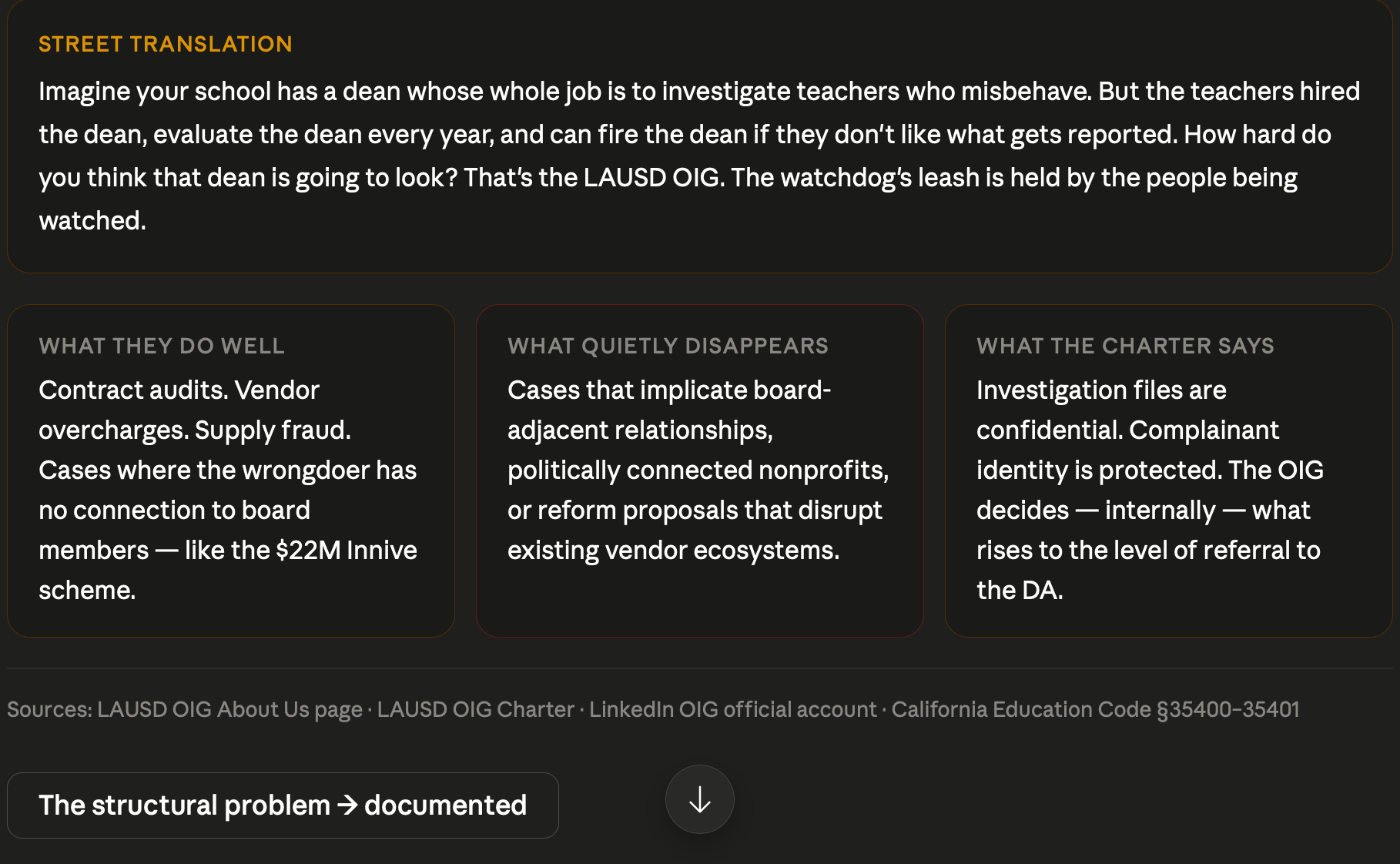
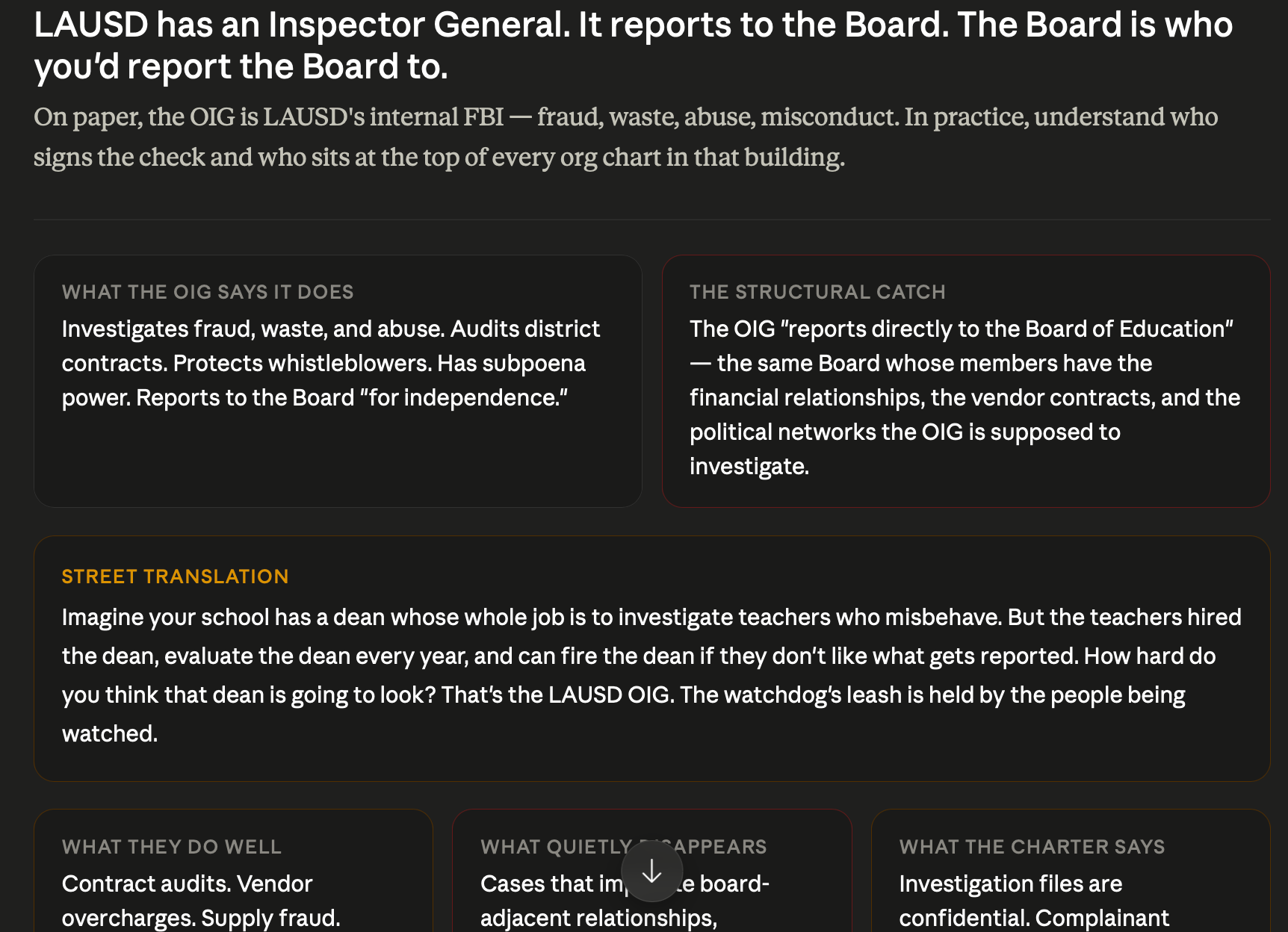
Every large organization needs sentinels. Los Angeles Unified has its Office of the Inspector General, a name that conjures images of stern auditors marching through ledgers like avenging angels. In practice, the OIG operates with a structural ambiguity that would delight a novelist of bureaucratic manners. It reports directly to the Board of Education—the very body whose work plan it must follow and whose members ultimately sign off on its priorities. The office may be independent of day-to-day district staff, yet it remains tethered to the Board itself, like a guard dog whose chain is fastened to the house it is supposed to circle.
True independence is a rare and brittle thing. It requires not just good intentions but architectural separation: walls thick enough that influence cannot whisper through them. When the watchdog’s mandate is shaped by those under scrutiny, accountability becomes a hall of mirrors. One sees the reflection of vigilance everywhere, yet the original image stays elusive.
Records as Reality
Bureaucracies do not run on handshakes or hallway conversations; they run on paper, pixels, and databases—the quiet architecture of what counts as truth. Student discipline, employee misconduct, safety incidents: all of it coalesces into official records that harden, over time, into institutional fact.
In 2025, LAUSD’s own Inspector General documented significant weaknesses in the district’s incident reporting system, known as iSTAR. The flaws were not cinematic scandals but the more insidious kind: gaps, inconsistencies, delayed entries, the slow erosion of confidence that comes when the ledger itself is porous. Records are the memory of an organization; when that memory is unreliable, decisions float free of their foundations. Future historians, or even next year’s investigators, will inherit a half-erased palimpsest and be forced to guess at what was once written there in bold ink.
The Subtle Currents of Influence
Modern public education resembles a coral reef: a living, growing structure built from the accreted labor of government agencies, nonprofits, foundations, consultants, and contractors. Much of this ecosystem is genuinely generative—greening schoolyards, supporting teachers, expanding opportunities. But reefs are also places where visibility is limited. Relationships overlap like branches in dense undergrowth.
Consider one public example. Board President Kelly Gonez has been a visible champion of school greening initiatives. Her husband, meanwhile, held a leadership role at TreePeople, a nonprofit that partners closely with the district on precisely such projects. The facts do not, by themselves, constitute corruption; they illustrate something more atmospheric. In a system dense with such adjacencies, transparency is not a luxury but the oxygen that keeps public trust from asphyxiating. Clear disclosure rules and genuinely arm’s-length oversight are not accusations of wrongdoing. They are the difference between a healthy reef and one where certain organisms thrive in the shadows while others struggle for light.
The Self-Preserving Machine
Large institutions, like ancient forests, develop their own logic of survival. They prioritize stability over disruption, continuity over reinvention. Problems are punted into committees. Responsibility diffuses across org charts until it becomes a mist no one can quite grasp. This is not usually the result of malice but of scale itself—an emergent property, as predictable as the way a river deposits silt until its channel grows sluggish.
Bureaucracies are masterful at protecting their own equilibrium. They resist the kind of sharp, external pressure that might force genuine course correction. Complexity becomes both shield and cage: so many moving parts that no single failure can be pinned down, yet the whole apparatus lumbers forward under its own momentum.
The Human Purpose
At its best, education is alchemical. It takes raw human potential—restless, curious, contradictory—and forges it into something capable of shaping the world: thinkers, makers, citizens who carry their communities forward rather than merely passing through systems. When institutions tilt too far toward self-management, when the machinery of administration begins to feel like the point rather than the servant, something essential is lost. Students become data points moving along conveyor belts. Agency withers.
The future belongs to systems that remember the human scale. Schools should not merely process children; they should ignite them—equipping them to become creators, problem-solvers, and builders who see institutions not as immutable fates but as things that can, with effort and imagination, be remade.
The Pattern and the Question
This is not a story of secret takeover. It is a story of structural drift. Oversight that reports to the overseen. Records with known frailties. A thickening web of partnerships whose full shape is difficult for any single citizen to apprehend. In such an environment, cynicism is easy but insufficient. The more rigorous response is curiosity—the persistent, slightly uncomfortable habit of asking better questions.
Public education still belongs, in theory, to the public. That ownership is only as meaningful as our collective ability to see how the system actually functions. Before we can improve it, we must first map it: not with slogans or conspiracy, but with clear sight, rigorous transparency, and the quiet insistence that no institution, however vast or well-intentioned, should be allowed to become a black box in which the public’s children and the public’s money move unseen. The supertanker needs pilots who can be watched, charts that can be read, and a course that the rest of us have some genuine say in setting. Anything less is navigation by faith alone—and faith, however sincere, has never been a substitute for sight.