The Land of Troy could get its first Trojan Governor
by Penelope Roberts
Politics in California has long operated as a sort of theater on a Coliseum-like scale. Celebrities have entered the stage to become governors, and charismatic personalities have charmed Californians at the peril of its citizens. "It's time for an intervention," Louis says. "I will lead a path that creates a contrast, a sort of redemption for our city."
Performative politics largely caters to the media for benefit of a concentrated wealth that largely resides in Los Angeles, while the underlying system quietly shapes outcomes long before the voters are informed about the reality that is governing them.
"The reality is that politics is an "insiders game" the public barely understands," Louis observes. "They feel it though. It's palatable - the dystopia." At least that's the USC Alumni (1994) has concluded in an exhaustive research effort to discover why education is failing in California.
Louis immersed himself in a solution that could come in the form of a story that could be seeded into California's current system to transition to a system that is responsive to our children. As a teacher for nineteen years, it turns out, that emotions are a natural compass for learning. "Resonance should guide our destiny," he explains. "Language just helps you point to your preferences; however, a container does not exist to achieve this the true power that exists inside every learner, a harnessing of emotions to find purpose. "That's the real force Star Wars was alluding to," Louis explains. "Therefore, an interest-based learning system is the only realistic way to align learning with children; the current system purposely does not validate children, unless they're obedient and motivated to get good grades - that gives the industrial age matrix a system of control, instead of welcoming children into our society, we throttle them, and make the feel lost.
The solution Louis developed began as an Xprize prompt; he discovered his solution could homelessness and create a local economic concept that makes living "more of an art than struggle." "That sounds a little esoteric," Louis says. "But the structure of micro-economies matches our brain capacity. We can only remember about 150 people. "It's an organic size built around a local narrative interface," Louis explains. "It an optimized reality built on resonance."
But just how would it work?
Louis envisioned it as a story that was sourced from the lessons of the local elders; storytelling would be the foundation of decentralization, where communities would be taught how to tell each other's stories to create the engine for a local economic structure. It was a vision of a next generation society that was organized by media in the form of a story - locals would create it, but they would have to learn the process. To make this possible, Louis create a plot line that began in the form of an interactive story called "The Golden Road".
It's the Sermon on the Mount meets the Wizard of Oz, meets Pokeman Go!" Louis says. "This are real characters in a real story though. This is reality."
Louis' path into politics is unconventional.
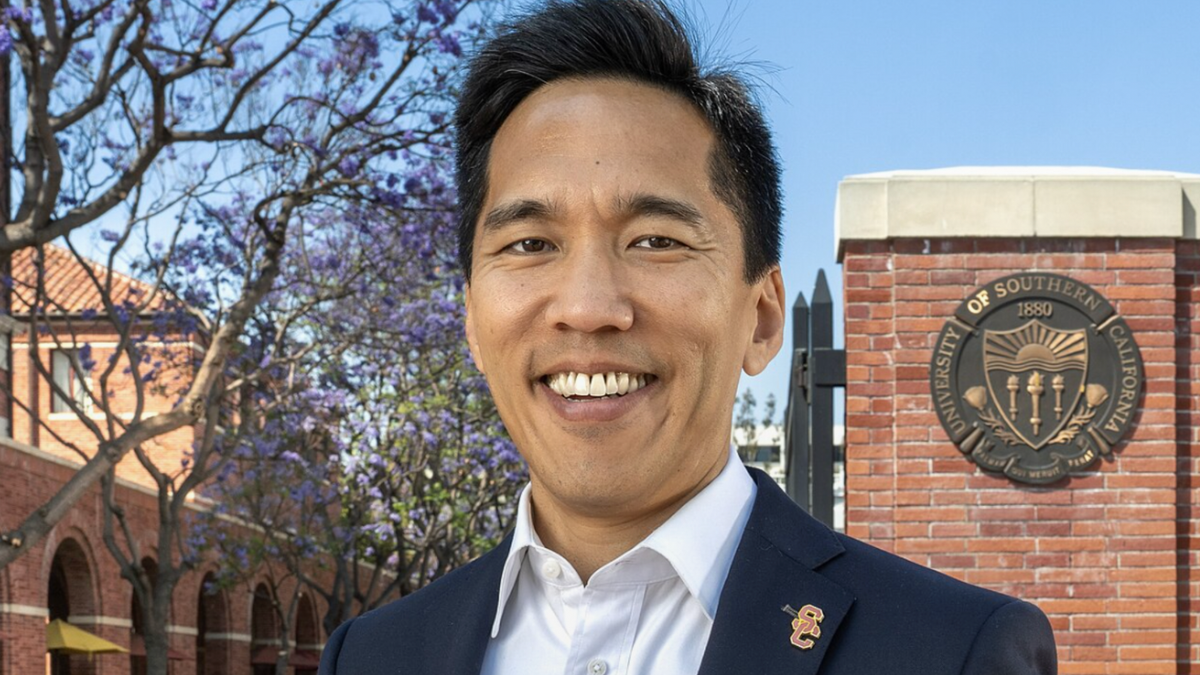
He arrived in Los Angeles his freshman year; he often referred to USC as the “Land of Troy” and marveled at how his story paralleled that of the Odyssey, where the central character infiltrates the city through a Trojan Horse.
"That's how I began to see my perspective," he shares. He saw himself as an archetype of a naive "Dorothy" whose journey gradually revealed the reality behind the curtain.
Armed with a literary education from his alma mater USC, Louis felt he would have been ill-prepared for the challenges without his education in the Land of Troy, an experiencing spanning thirty-four years - from Los Angeles, Orange County, and the Inland Empire - he immersed himself into Southern California.
When it came to uncovering the illusion behind the Land of Oz, he remembered how his USC Professor Starr referred to Los Angeles as the "Pueblito de Los Angeles" founded as a Spanish colony, a destination of El Camino Real, replaced by Ventura Boulevard, a street just blocks away from the Woodland Hills home where he had co-raised his two children.
Like Dorothy, Louis bubble burst when he was awakened out of the illusion by what he found deep inside the public school district. Louis found himself awakening to the reality of Los Angeles. He soon realized that his latent interest in politics had become activated when he witnessed the action of the Los Angeles Unified School District under the leadership of Alberto Carvalho and the Head of the LAUSD school board, Kelly Gonez, a local from Pacoima, who succumbed to the industrial age matrix, by accepting indirect incentives through her husband's employment.
"What bothers me the most about this," Louis explains. "Is that Kelly Gonez signed the paper that fired me from LAUSD. They were all clearly false allegations, and she signed the paper. That's when I realized that a woman who seemed so nice on the surface was really doing harm to our children. "She was naive, and corrupt in a way that clearly was enabling the school district."
Louis discovered about the real circumstance of the children of Los Angeles. They were in a real Temple of Doom - pure blight looks like "nobody cares" in reality. Los Angeles appeared to be worsening year-by-year, instead of improving
He went to places in Los Angeles few had access to. When he saw what he did, it had reminded him of what he had seen in India. The reality he witnessed revealed the true nature of what was occurring, and when he tried to talk to senior LAUSD officials about a solution, they blatantly targeted him. That was the response to someone trying to begin a discussion about how to fix a broken system.
"We have all born into the spell of the industrial age matrix. Our parents were enslaved by the same system that owns the media that narrates our reality. There's a way out," Louis says. "We can get free through a process that uses the constitution as the creative brief."
For Louis, the prospect of entering politics as an outsider was daunting; but he saw it as the final action to his research - an intervention.
"The only real way to make the system work as it should be," Louis says. "is to create a simulation of how it would work."
When LAUSD targeted him in 2019, Louis was forced into paid isolation for four years. For the first time, he had his mind to himself. The time to think was transformational. That's when he decided develop a realistic path to become Governor of California.
He decided to do a practice run as the Los Angeles Mayor where he would capture more data of the current state of the political system. \
"California is currently in a dystopia," Louis concluded in 2021. "The data from his story would seed an intervention."
When LAUSD target him him, LAUSD didn't know he was recording the sequence of events into a plot line that he would triangulate to figure out the pattern they had created for systemic corruption against teachers; he revealed this process to the office of Rob Bonta; and he is now sharing the story through his governor campaign, hoping to engage the media in a conversation in the reality that is occurring.
An intervention meant he would have to become California Governor. In his own mind, he entertained the parallels of Odysseus' journey; he had entered the "Land of Oz" through the Land of Troy, and he was riding the Trojan horse to victory. While not quite as epic as the Odyssey, what he experienced had parallels that seemed almost written.